We live in Kern County, which grows roughly 11% of all US fruit, nuts, and vegetables, and where roughly 46% of all land in the county is devoted to agricultural use. Bakersfield is the 9th most populous city in California. We have countless new markets popping up across the city each year. So why is it that every time you go out to eat at a new restaurant, it tastes just like the last five you visited? What some might call "mid."
The Path to Entitled Tastebuds
Just after finishing up high school, I started working a summer job at Murray Family Farms doing farmers markets all across Southern California. If you have never been, I would say drop what you are doing now and go check it out, but it is quite hot outside so best wait for a cool day or until October for the Pumpkin Patch. If you or someone you know is looking for a summer job, now or anytime in the future, I recommend reaching out, as they are always in need of more help during the peak season.
I wholeheartedly feel my experience working for them was not only a rite of passage but exactly the spark under my butt to pursue my career and finish up college. Okay, enough with the shameless plug of that fine establishment and beautiful family.
One of the biggest things you learn when selling fruit is the power of the sample. Tons of people walk by, see your stall with the best display of produce you could muster that day, and often just keep it moving. Little do they know, you are sitting on some of the best fruit in the world and charging more or less what they would pay in a grocery store.
So you kick it up a notch. You grab your tongs, hold up a slice of fruit, and do your best to get them to laugh. "Sir, have you ever tried a blackberry that would blow your socks right off your feet, shoes still on?" Most folks cannot resist turning to see what human being would dare make a claim such as this. That is the hook, and honestly the hardest part, as it requires a mixture of charisma, confidence, and insanity.
For the folks that do take the bite, they approach you, try the sample, and it is basically game over. But just to seal the deal, right as they plop the juicy blackberry into their mouth, you hit them with, "they are so good you can almost feel the sugar glide across your tongue, like eating a freshly baked pie straight out of the oven." The trick here is that you paint a picture in their head, creating a memory portal which takes them back to a fond memory of eating a pie, and they associate that feeling with now. That part is crucial.
Waking up early to drive to and conduct the farmers markets in the heat may have increased the insanity a bit, but I swear to you this worked more often than it did not. Perhaps some might label this subversive tactic negatively, but I was passionate about it and truly felt that I was spreading the love of the taste rather than bumping our sales another four bucks for the day. Don't hate the player, hate the game.
As much as I enjoy tooting my own horn, what made that job the easiest by far was that a majority of the produce was genuinely the best you had ever tried. The Murrays not only have some of the best produce, but where they also shine is in the countless varieties they grow of each fruit. When you go to a grocery store to get blackberries, strawberries, or blueberries, you get whatever variety they are pushing and you choose Organic or Non-Organic. At these farmers markets, it was rare for us to ever sell a single variety of a fruit. Each week new varieties would get picked, and over a full season you'd sometimes encounter upwards of 20 varieties of a single fruit, all the while there are people all across the United States who may not even know there are different types of the same fruit.
After the season, I had convinced myself I could tell the difference between all the varieties, and at that time I probably could. Unfortunately, this change in my taste for fruit came with a cost. My parents often would still buy fruit at the grocery store and, nine times out of ten, it was like eating cardboard. Over time your entitled tastebuds do eventually dull, but I will never forget that phenomenon.
After a few years at Bakersfield College and doing markets in the summer, I eventually went off to college on the coast. The food was generally great there, and even the cheap food targeting college kids was pretty good. There was an ice cream shop my friends and I would visit in the downtown area after a night of not studying. If your double vision wasn't too bad, you would see a whiteboard while waiting in line for a good 15 minutes, and on it would be all the flavors they had that week and the different farms they sourced the ingredients from. Every week that whiteboard would have new inscriptions on it. Sometimes you'd pick a flavor that was okay, like butter beer, and sometimes you'd try one and think this has got to be the best ice cream I've ever had. A feeling surprisingly not unfamiliar to me.
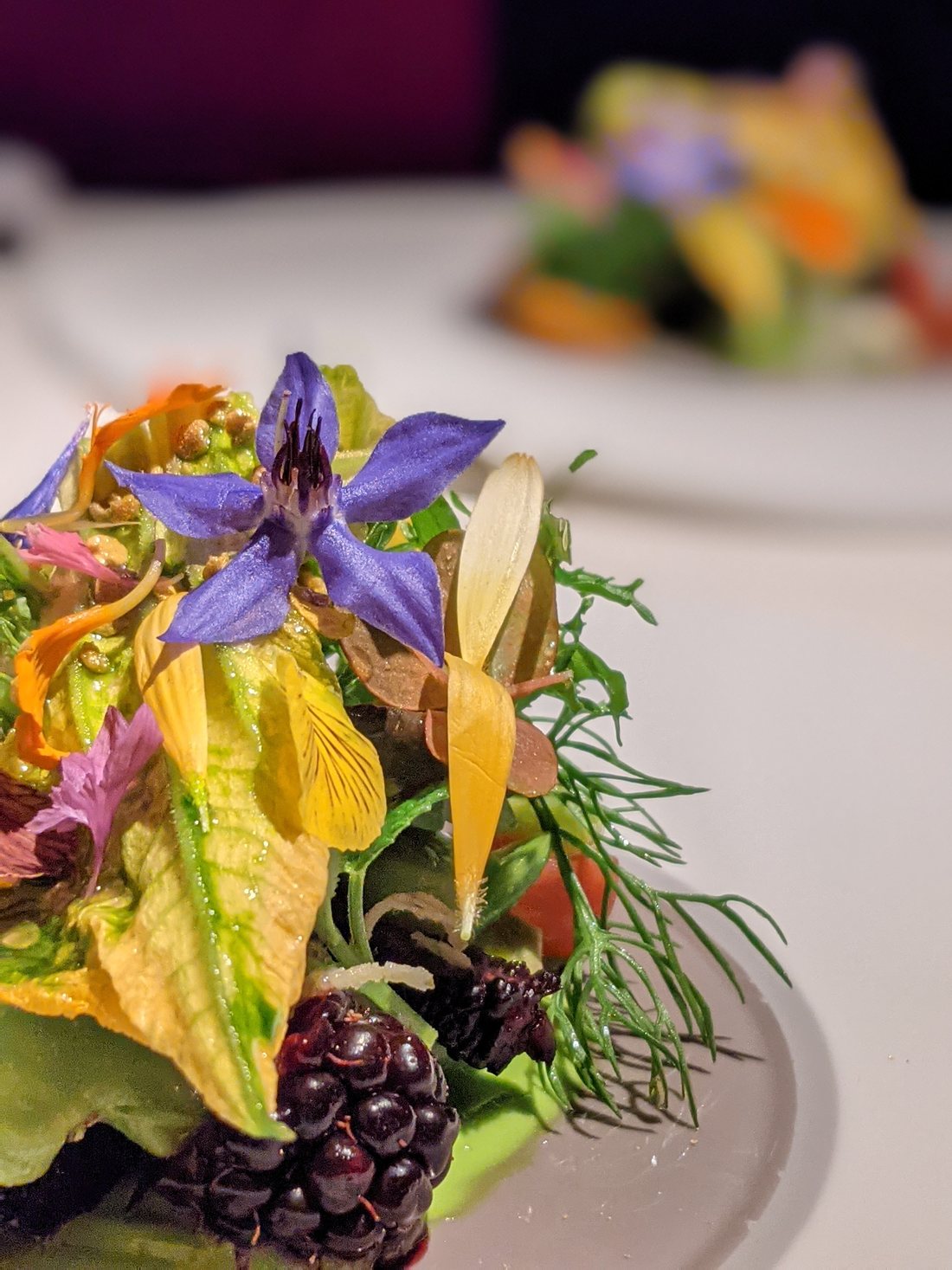
Cut ahead almost a decade, while living in the Bay Area, my girlfriend now wife and I went to a 3-Meesh, or Three Michelin Star restaurant, for my 30th birthday, and we were blown away. The presentation was incredible, the flavors of each dish were wildly different and nostalgic, and the service was impeccable. A staff member came by about halfway through our meal to ask how things were, then proceeded to pull out a tool to scrape a single small crumb I had dropped off the table into a white cloth before scurrying away.
For the cost we paid, I am sure most would say I should not be surprised. But as my first experience in that crazy world of high-end food, it was priceless. The funny thing is, though, that although this was my first time going to a Michelin star restaurant, it was not my first encounter with the world of high-end food.
Oftentimes when doing farmers markets in Santa Monica, Hollywood, or even Las Vegas, chefs would come pick up wholesale orders directly, or their food sourcing staff would come pick them up at the market. In some cases the chefs who visited did in fact run restaurants with Michelin stars, and that sourcing staff would be shipping the food to high-end restaurants all over the country.
This should not be too much of a surprise. The Murrays have won most loved vendor at the Santa Monica farmers market eight consecutive years, sometimes competing against up to 75 farm and food vendors. And the Murrays are not alone in the game of quality produce over quantity. There are so many small vendors across the state, and certainly in Bakersfield and Kern County, that also have extremely tasty produce. I imagine most people don't really know the power we wield in our little big city's backyard.
Why the Best Restaurants Aren't Where the Food Grows
My wife and I moved to Bakersfield not long ago, after having our first child, because we heard the homes here were slightly cheaper than in the Bay Area. A few weeks ago we went on a date night and had some sushi at a slightly upscale joint. The presentation was top notch, which is one of the big pieces to reaching for the Michelin stars, but the food was somewhat bland. Unfortunately, I have noticed this more and more across the various restaurants we have tried. So why might that be? Well, you now have my permission to put your tin foil hat on for the rest of this blog.
In the same way that when you go to a grocery store you surprisingly don't find a whole lot of local food, and if you do it is from one of the small handful of big ag companies in our county, many restaurants end up following a similar path for sourcing their food. Just like the food sourcing at the farmers markets, there are mega corporations that do the same. The difference is they rely on a vast network of large farming operations to supply restaurants all over the country.
There are two companies in particular known for being the biggest, and I see their trucks all across Bakersfield. More often than not you'll see them pulling up into the back of your favorite restaurants in town, and once you start to notice, you can't unsee it. One in particular had an Instagram account with the brand name and eventually changed it to something less big-corporation sounding. Although it might not seem like a big deal at first glance, if every restaurant is provided the same meat, fruits, vegetables, or even frozen french fries, then the food at every restaurant may start to taste the same.
It would be impossible to fully condemn relying on these companies. Most ingredients are not grown year round at every small local farm, and these distributors have enabled countless new restaurants to open and enrich the community. I think the biggest reason they have made it easier for all these new restaurants to open is the convenience of having everything you need delivered at the same time. No need to manage multiple vendors, and you can confidently keep a set menu practically for the lifespan of the restaurant.
The problem, though, is that most of the items they source may not actually be coming from the small farms in Bakersfield. Those top food distributors boast that they source their foods from under 400 miles away, but the only way to do this is to rely on a vast network of large farms that can keep up with such mass distribution. So all the berries likely come from Watsonville, and the lettuce comes from Salinas, Hanford, or Arizona, and so on.
These big farms then have to rely on state-of-the-art techniques to ensure the longest shelf life of their produce, using sprays to keep the fruit looking shiny and staying firm at the cost of taste. On top of that, the fruit can lose a substantial portion of its beneficial nutrients in just the few days it takes to reach a grocery store or restaurant. With this in mind, it is actually quite logical why the food may taste bland. What concerns me most is just the sheer dominance these companies have over the community.
What the Numbers Actually Say
As an exercise, I'd suggest searching online for any "Farm to Table" restaurants in town, or any other synonymous phrase, to find a restaurant which sources a majority of its produce from local Kern County farms. Sadly, the results are sparse. From what I have found, you can count them all on one hand. There very well may be more, but they are certainly hard to find.
The USDA's 2022 Census of Agriculture counts 1,691 farms in Kern County, and 85% of them are family farms. The "small family farm" designation goes to any family operation pulling in less than $350,000 a year in gross cash farm income, a threshold the USDA raised from $250k back in 2013. The Census doesn't publish that exact cutoff county by county, but the cutoffs it does publish tell the same story: 45% of Kern farms, or 766 of them, sell less than $100,000 a year, and 42%, or 704, sell less than $50,000. Meanwhile the 925 farms selling $100,000 or more account for essentially all of the county's $5 billion in annual sales.
The number that stopped me cold, though, was this one: only 4% of Kern County farms sell directly to consumers. That is something like 68 farms, in the county that grows a tenth of the nation's produce.
It is highly likely none of those small farms are included in the circuit of the top food distributors. In fact it is probably only a small handful of the big farms, because they have the means to keep up with the mass distribution needed to consistently supply food for so many people. So when you go to a restaurant and get a fancy cocktail or dessert, even though the fruit they use is in season and growing at a farm a few blocks away, it's more than likely coming from far, far away, and so tasteless they need to cover it in sauce.
I wanted to see these farms on a map, and it turns out you cannot. The USDA is barred by law from ever releasing farm-level records, so nobody outside the USDA knows which specific farms carry that "small family farm" designation. The closest thing we have is the county's own Williamson Act rolls, which track every parcel whose owner has signed a contract to keep it in agriculture. Kern County publishes all 11,624 of them for free, with acreage attached, so I plotted them.
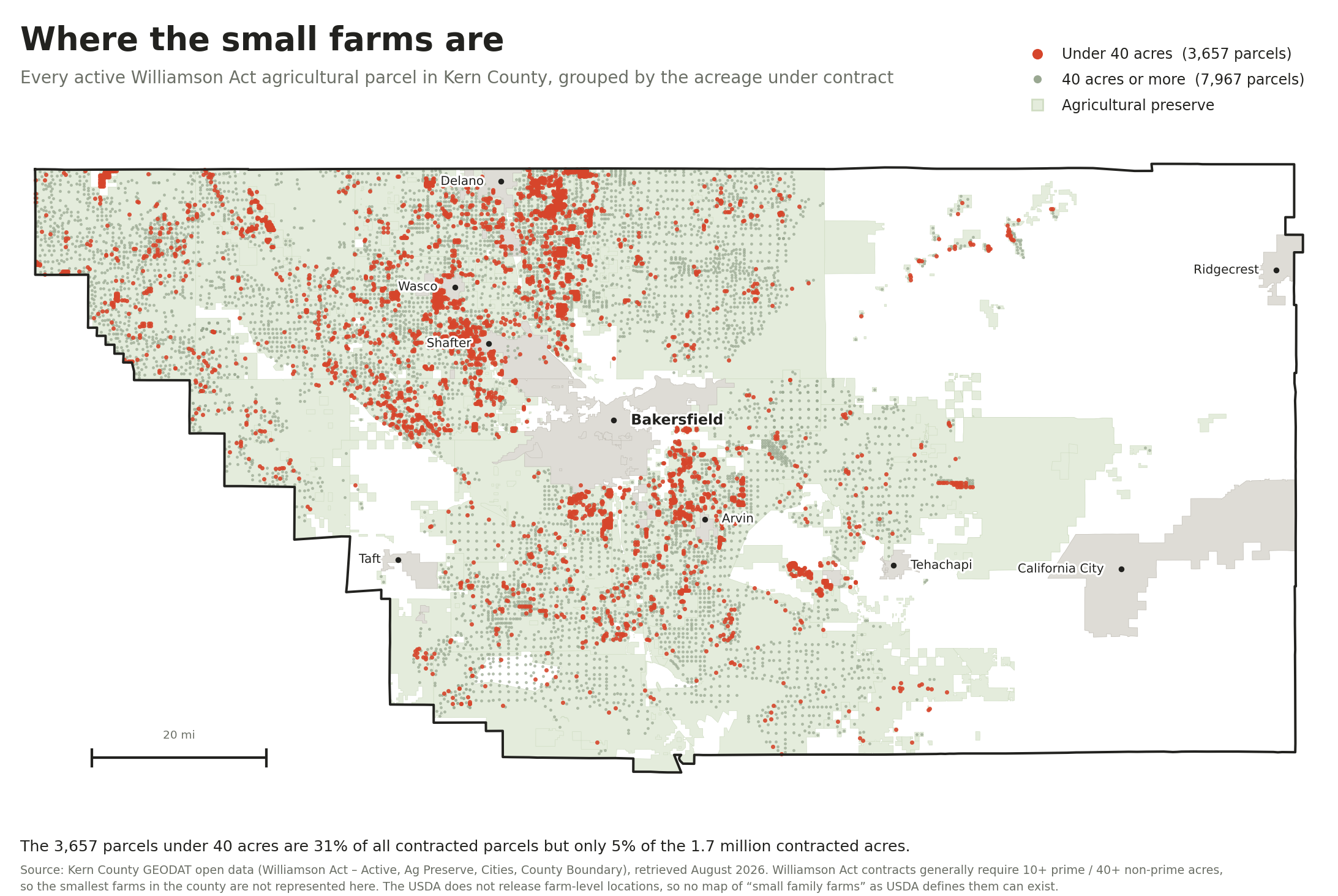
The shape of it says everything. The 3,657 red dots, every contracted parcel under 40 acres, are 31% of the parcels on this map and 5% of the 1.7 million acres. All that green filling the valley floor is the other 95%.
And the red clusters are not scattered evenly out in the county. They bunch up right against Bakersfield, Shafter, Delano, and Arvin. The small farms are already sitting on the doorstep of the restaurants that aren't buying from them.
Fair warning on the map: a Williamson Act contract generally requires at least 10 prime or 40 non-prime acres, so the very smallest operations in the county, the ones on five acres selling everything they grow at a Saturday market, never show up here at all. If anything, the map undercounts the people I am talking about.
So Why Isn't Anyone Buying Local?
I have put a lot of thought into the question of why there are not more restaurants taking advantage of this food oasis we live in. A few things came to mind, both from research and from speculation.
The first and most severe concern is that some of these food distributors apply fear tactics, either implicitly or explicitly, by informing restaurants that if they source food from any other company they will be cut off, and perhaps even blacklisted if they try to go to a competitor. That seems like an antitrust lawsuit waiting to happen, so I give them the benefit of the doubt that this is not the case.
The second came from some research, and it has a few angles. Food distributors may provide incentives in the form of discounts if a restaurant only uses them as a source, so think you get 15% off forever if you only shop with them. Another angle is that the more you buy the more you save, which is a common tactic even in retail and grocery stores.
Some other ideas put more of the onus on the restaurant, and it mostly comes down to convenience. If you have multiple food sources, either via deliveries or through picking up in person, it takes more time and effort. Needing to juggle the bookkeeping and coordinate multiple deliveries or pickups just adds more load to a restaurant which may otherwise be struggling to just keep the lights on. In all cases it tends to come down to money and time.
And how can we blame anyone for wanting to save money or time when we ourselves will DoorDash food from across the street, or order something online we don't really need and could easily pick up in person that same day? Often a big company will make the news for doing something foul and some of us will take a stand and boycott, but over time our morals weaken and we get right back on the gravy train. I could sit here and condemn the system, but I would be a hypocrite if I didn't admit to fueling the machine just like everyone else.
So where does that leave us, and where does this blog post go from here? A call to arms for local restaurants, and an encouragement for you fine people to support those establishments which take a stand.
Call to Arms
Restaurants and Bars
Now, I don't have any background in running a restaurant or bar, and although I can only speculate on the difficulty, I have to imagine it is tough. I do not cast blame on any restaurant that is just trying to get by, and I have found many which do well without local produce.
Instead, I want to encourage all restaurants to try incorporating some local produce into their menu in some way. You don't have to convert hardcore overnight, and in fact I wouldn't recommend that, as it might end poorly. Take it in baby steps. We have some of the most diverse seasons of produce in the world because we get little rain and it rarely gets below freezing, so something is growing all the time. Whether it is one dessert on your menu where you add blackberries or cherries for three months out of the year, or whether it is offering freshly squeezed orange juice in the winter and spring.
And when you do this, please make it known. Maybe don't shout it from the rooftops, or maybe you do, but at least mention it on the menu and drop the name of the farm you sourced from.
If the hang up is not knowing what is ready when, here is the whole year on one page. Print it, tape it up in the back of house, and build one dish a season around whatever the chart says is peaking.
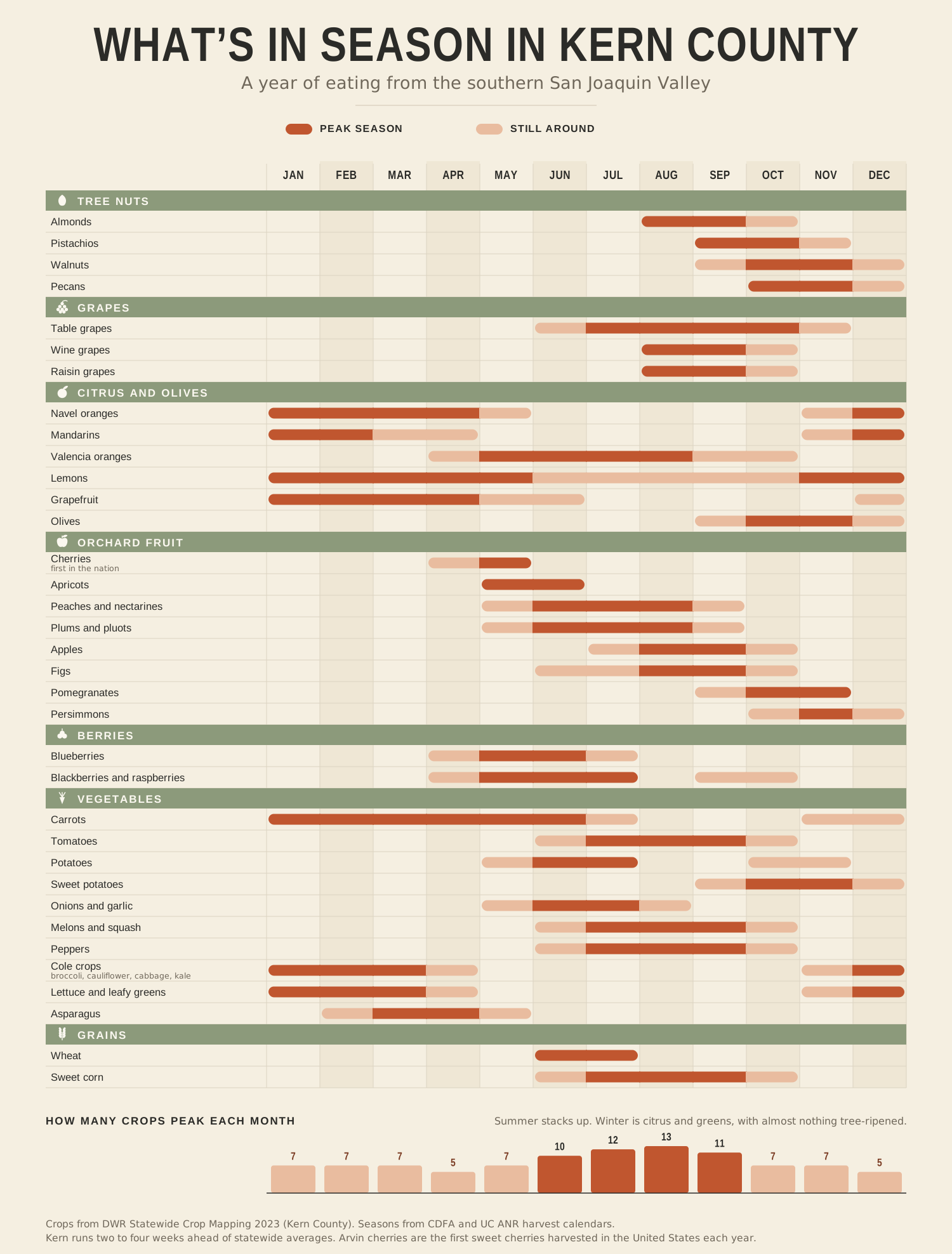
The cherries are the part I'd point at hardest. Arvin grows the first sweet cherries harvested anywhere in the United States. They show up at the end of April and they are gone by the end of May. That is a four week window where a Bakersfield restaurant could put something on the menu that literally no one else in the country can. Same story with table grapes in June, where Kern kicks off the entire state's season.
Not only will the taste stand out, you will be supporting a local farm, and maybe one day they will make more than $50k in sales, or better yet break out of the "small family farm" designation and clear $350k in a year.
The funny thing which most may not even realize is that yes, food at the local farmers market may be more expensive, but if you make a deal with the farm they may be willing to offer a much more lucrative rate, just like those food distributors do. And if you are fearful of the food distributors catching a whiff of your mutiny, then just cover your tracks. They shouldn't have access to your finances, and I highly doubt they'd notice if only 5% of your sourced food doesn't come from them. You are but a small fish in the massive sea of restaurants they distribute to.
Over time, if you find that you are able to break away even further, who knows. You may be getting a visit from the elusive Michelin reviewers someday, or maybe you revive the mayor of Flavortown from the ashes and get featured in the elite Bakersfield Triple D lineup.
You the People
All of this effort cannot simply fall on the shoulders of the restaurants and bars. You and I need to get out there too. If you stumble upon one of these farm-to-table establishments making an effort to support local farms, go and check it out. The proof is in the pudding, and I'd be willing to bet it is worth the adventure. If you like it, or even if you don't, tell your friends and family.
Just like trying new things when you cook in your own kitchen, these spots might not hit the mark every time. But what you can assume is that if they tried it once, they might try it again. Those are the spots where you will eventually find the best food you ever had, because they have the attitude to try, fail fast, and start over until it's perfect. I'm sure everyone remembers the bad rap food trucks got a while back, and now some of the best food you'll find is at a food truck. It is the same hurdle in a different form, and some day everyone will be hip to it.
The establishments are also not the only ones who can source their food straight from the farm. If you are not checking out the local markets, you are falling behind. I've seen at least five new farmers markets pop up throughout the city in just the last few years, and they constantly have fresh produce, eggs, meats, honey, and more. There are also many really great food vendors trying to make a name for themselves so they too can someday get a place of their own and not have to make their confections at home. You never know when you might be trying the beginnings of one of the best spots in town.
And go look up your local farmers. Just like the chefs, you can also make a deal and pick up a collection of fruits and veggies on a regular basis. If so many farms are making so little in sales, any business is good business, and spreading the word about their great offerings may be what ends up saving them from shutting down.
Convince Me More
Given the aggressive tone I've taken in this post, I really hope you have not painted my voice to be as whiny and harping as it may well be, but I commend you for making it this far.
If you still are not convinced, and you feel there is no difference in the taste of the two week old produce you get at the grocery store versus what you'd get at a local farm, then my final suggestion is this. Go to Murray Family Farms now, or next season, and pick up a carton of Kiowa blackberries. Close your eyes, toss back one blackberry, and think back to a time when you were eating some freshly baked pie.
Cherish that moment as your awakening to the world of taste. And whenever someone offers you a blackberry in the future, ask them what kind it is, because there is a difference and now you know it.
Rest in peace, Sean Murray.